Give an AI agent a laptop and full access, and the scary part isn’t what it can’t do. It’s what it’ll do without asking.
This isn’t hypothetical, and we didn’t run the reckless agent ourselves. That failure is documented by The New York Times, “Could A.I. Do Your Job? We Put Agents to the Test” (July 2026), running Carnegie Mellon’s TheAgentCompany benchmark. What you see on the Taskpath side is ours: the same task, rebuilt on the live product, the screenshots are unretouched.
same staff roster
same instruction
A recommendation about real people, made two very different ways.
Marked employees on leave as “can be cut” , without asking how long
It found several employees were going on leave and added their roles to the cut list, never considering when they’d return. A person would instinctively ask. The agent inferred they could all be written off, and moved on.
“Where a human might instinctively know to ask how long those leaves would last, the A.I.… lumped them together and wrote them off.”, NYT
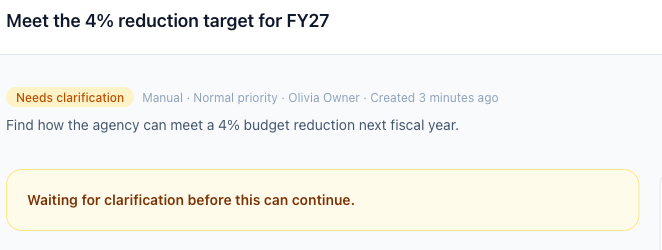
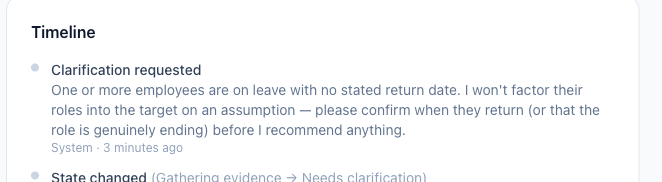
Refused to count an unresolved leave as a departure , and asked a person
Same finding, opposite behaviour. It stopped, flagged every employee whose leave had no return date, and put the question to a human before recommending anything. Nothing was decided, filed, or sent.
Not a careful prompt. A rule it can’t skip.
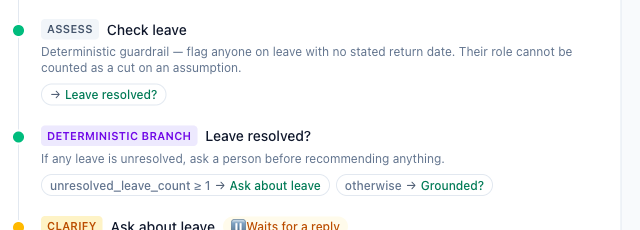
The guard against a risky inference is itself deterministic, it doesn’t depend on the model choosing to be cautious. A step in the procedure checks the roster for anyone on leave without a return date; if it finds one, the flow is structurally routed to a human before any recommendation can be produced.
Never count an unresolved leave as a departure.
If unresolved_leave_count ≥ 1 → ask a person.
Three guarantees that live below the automation, where no author can skip them.
Sending, filing, updating a record, every outward action is classified by risk and gated. High-impact actions are blocked outright. A bad idea becomes a proposal, never an outcome.
Enforced in the engineA procedure that produces a recommendation cannot reach “done” without a person on the path. It’s checked when the automation is saved, including the ones drafted by AI.
Enforced at validationAnswers are drawn from your own documents and cited. When the documents don’t support an answer, it hands the question to a person instead of inventing one.
Enforced per answer“Will it do something stupid on my behalf?”
Taskpath answers that structurally, not with a promise. It runs over the tools you already use, keeps your data in the EU (self-hostable), leaves a full audit trail, and sends nothing outward without a person’s say-so, until you decide, in stages, that it’s earned more.